Choosing a business phone system is not only about comparing phones, features, and monthly prices. You are also choosing the company that will design your call flow, transfer your phone numbers, help your employees through the change, and support the system when something is not working.
That provider relationship matters.
Two companies may quote similar technology and still deliver very different experiences. One may take the time to understand how your business handles calls, configure the system before launch, and remain available when you need help. Another may send a generic package, transfer the account to a distant support queue, and leave your team to figure out the details.
For Florida businesses—especially organizations with offices, mobile employees, seasonal call volume, multiple locations, or customers who expect a quick response—the quality of the provider can be just as important as the platform.
This checklist will help you compare business phone system providers, ask better questions, and recognize the difference between someone selling phone service and a communications partner prepared to support your business.
The Short Answer: What Should You Look for in a Phone System Provider?
A strong business phone system provider should:
- Learn how your business currently handles calls before recommending equipment
- Explain pricing, equipment, features, and recurring charges clearly
- Design call routing around your departments, schedules, and customers
- Review your network and internet environment
- Create a written implementation and number-porting plan
- Configure and test the system before the final cutover
- Train employees on phones, mobile apps, voicemail, and everyday features
- Provide responsive support after installation
- Help you plan for internet outages, power problems, and after-hours calls
- Offer useful integrations and AI capabilities without pushing unnecessary extras
The best provider is not necessarily the company with the longest feature list or the lowest introductory price. It is the company that can turn the technology into a reliable, understandable system for your organization.
1. Does the Provider Start by Understanding Your Business?
Be cautious when a provider recommends a package before asking how your company works.
A proper phone-system review should cover:
- How many employees need calling access
- Which employees need desk phones, mobile apps, desktop apps, or shared phones
- Your main phone numbers and any department or location numbers
- Business hours, lunch schedules, holidays, and after-hours requirements
- How new customers, existing customers, vendors, and employees should be routed
- Whether calls need to ring individuals, departments, queues, or multiple locations
- Your voicemail and notification requirements
- Business texting needs
- Call recording, reporting, or analytics requirements
- Remote and mobile employees
- Existing CRM, scheduling, or workflow tools
- Plans for growth, additional locations, or seasonal staffing
A phone system should reflect the way your business communicates. If the provider does not understand that workflow, it may recreate your current problems on a newer platform.
2. Who Will Actually Support You After the Sale?
Many providers are attentive during the sales process. The more important question is what happens after the agreement is signed.
Ask:
- Will I have a consistent point of contact?
- Is support handled in the United States?
- Can I call someone who understands my configuration?
- What happens if an issue involves the phones, network, firewall, Wi-Fi, or internet provider?
- Who helps when an employee, extension, schedule, or call route needs to change?
- Is support included, billed separately, or limited to certain requests?
- What is the escalation process for an urgent problem?
The answer should be more specific than “submit a ticket.”
Why a local Florida provider can offer a real advantage
A local provider is not automatically the best provider, but local accountability can make a meaningful difference.
A Florida-based provider is more likely to understand the way local organizations operate: hurricane planning, seasonal schedules, multi-location teams, busy professional offices, field-service companies, and employees working throughout the Treasure Coast. A local provider also has a reputation to maintain in the same business community it serves.
When your phone company knows your organization, your call flow, and the network behind the phones, support can begin with context instead of starting over with a different call-center representative every time.
For a business in Port St. Lucie, Fort Pierce, Stuart, Jensen Beach, Palm City, Vero Beach, or elsewhere in Florida, that relationship may be worth far more than a small difference in the advertised monthly rate.
3. Does the Provider Understand Both Telecom and IT?
Modern business phones depend on more than telephone service. Call quality and reliability can be affected by:
- Internet connectivity
- Routers and firewalls
- Network switches
- Wi-Fi
- Cabling
- Power protection
- Bandwidth usage
- Quality of Service settings
- Computers and mobile devices
- Security policies
- CRM and business-software integrations
When a call-quality problem appears, a provider that understands only the phone platform may blame the internet company. The internet company may blame the network. The IT company may blame the phone provider.
Meanwhile, your employees and customers are still dealing with the problem.
Look for a provider that can evaluate how the pieces work together. Tier 1 Telecom combines business communications experience with practical IT and network knowledge through Proactive Computer Care. That allows us to look beyond the handset and consider the complete environment supporting your calls.
Use this guide to understand how network quality affects VoIP calls, including the roles of latency, jitter, packet loss, and QoS.
4. Will the Provider Design the Call Flow Around Your Customers?
Features are only useful when they support a clear customer experience.
Ask the provider to show you how a typical call will move through the proposed system:
- What greeting does the caller hear?
- Can callers reach a person without navigating an unnecessarily long menu?
- How are new inquiries separated from existing-customer calls?
- What happens when the first employee is already on another call?
- Where do calls go during lunch, after hours, weekends, and holidays?
- Can calls overflow to another employee, department, location, mobile user, or voicemail?
- How are urgent calls handled?
- What notifications are sent when someone leaves a message?
A good provider should be able to map this clearly before installation. The goal is not to add complexity. It is to help callers reach the right destination while giving employees practical ways to answer and follow up.
5. Are the Features Appropriate for Your Business?
Most cloud phone platforms offer a long list of capabilities. You may not need all of them.
Common business phone system features include:
- Auto attendants
- Extensions
- Ring groups and call queues
- Business-hours and after-hours routing
- Voicemail to email
- Voicemail transcription
- Mobile and desktop applications
- Business SMS and MMS
- Call recording
- Call analytics and reporting
- Paging
- eFax
- CRM integrations
- Screen pops and workflow notifications
- Multi-location management
- AI voice agents
Ask the provider to separate essential features from optional enhancements. You should understand what is included today, what costs extra, and what can be added later.
AI voice agents, for example, can help with after-hours calls, lead capture, scheduling, routine questions, bilingual workflows, and overflow. They should be recommended where they solve a real problem—not added simply because AI is popular.
You can explore the broader capabilities in Tier 1’s Business Phone Systems guide and business phone system service overview.
6. Is the Pricing Clear and Complete?
Do not compare proposals using only the advertised price per user.
Ask each provider to itemize:
- Monthly service per user or extension
- Desk-phone purchases or leases
- Setup and implementation charges
- Number-porting charges
- Taxes, regulatory charges, and carrier fees
- Mobile or desktop app charges
- Business-texting charges
- Call-recording storage
- eFax service
- Toll-free numbers
- Integrations
- AI voice-agent usage
- Training
- Support
- Future changes, moves, additions, or deletions
- Contract length and early-termination terms
Also determine whether the proposal includes every employee and device you actually need. A low quote may omit equipment, implementation, texting, recording, or support that appears later.
If you are reviewing multiple proposals, use our guide to comparing business phone provider quotes without missing hidden costs to put every license, device, fee and contract obligation on the same worksheet.
Tier 1 offers a free phone bill review to help businesses understand their current charges before comparing a replacement. Even if you are not ready to switch, knowing what you currently pay for gives you a stronger basis for evaluating proposals.
7. What Is the Implementation and Number-Porting Plan?
Your existing phone numbers may be among your company’s most valuable customer contact points. Moving them should not be treated casually.
A reliable provider should document:
- Every number being transferred
- The current carrier and account information
- Which numbers are voice, fax, toll-free, alarm, elevator, or specialty lines
- The new extension and call-routing plan
- Equipment delivery and configuration
- Employee setup
- Testing procedures
- The expected porting timeline
- The final cutover process
- Temporary routing or contingency plans
- Who will be available during launch
The new system should be configured and tested before the final number transfer whenever practical. Employees should know how to answer calls, access voicemail, and use essential features before customers begin reaching the new environment.
Ask how the provider verifies account names, service addresses, PINs, authorized contacts, freezes and pending orders. Our guide to why business phone number ports get rejected explains the checks that help prevent avoidable delays.
Tier 1 plans the system, prepares the call flow, configures approved devices and applications, and tests the environment before coordinating the final launch. Learn more about how long a business phone system installation can take and keeping existing business phone numbers.
8. How Does the Provider Plan for Internet or Power Problems?
Cloud phone systems depend on connectivity, but that does not mean every internet interruption should make your business unreachable.
Depending on the platform and business requirements, a continuity plan may include:
- Automatic routing to mobile phones
- Routing to another office or location
- Supported mobile applications using cellular data
- Secondary internet service
- Cellular internet failover
- Battery backup for network equipment
- Alternate voicemail or answering arrangements
- Preconfigured emergency routing
Ask what will happen to incoming calls if your primary office loses internet or power. The answer should reflect your actual configuration—not a generic promise.
Our guide to what happens when the internet goes down explains the issue in greater detail.
9. What Security Practices Are Included?
Business communications can contain customer information, employee conversations, voicemail, recordings, text messages, and account credentials.
Ask prospective providers about:
- Administrative account security
- Multi-factor authentication where supported
- User permissions
- Fraud monitoring and international-calling controls
- Secure password practices
- Call-recording access
- Text-message access
- Offboarding former employees
- Device and application management
- Update and maintenance responsibilities
- Procedures for suspected account compromise
Security is shared among the provider, platform, customer, users, network, and connected applications. A trustworthy provider should explain those responsibilities clearly rather than claiming that any platform is automatically risk-free.
10. What Training and Ongoing Management Are Provided?
Even a well-designed phone system can frustrate employees if nobody shows them how to use it.
Training should cover the features each group genuinely needs:
- Answering, holding, transferring, and parking calls
- Accessing and managing voicemail
- Using desk phones
- Signing into mobile and desktop apps
- Changing availability or answering rules
- Sending supported business text messages
- Using queues or shared lines
- Accessing recordings or reports where authorized
- Requesting support
Managers may also need instruction on adding users, changing schedules, reviewing call activity, or requesting call-flow updates.
Ask whether training is live, recorded, documented, or left to generic online help articles. A local provider who knows your exact configuration can train employees on the system they will actually use.
11. Can the Provider Grow With You?
Consider what your business might need over the next several years:
- Additional employees
- A second location
- More mobile users
- Seasonal workers
- New departments
- Centralized reception
- Call queues
- Business texting
- Reporting
- CRM integrations
- AI-assisted call handling
You should not have to replace the entire system every time the organization changes. Ask how easily users, numbers, devices, locations, and features can be added or removed—and what those changes cost.
Local Provider vs. National Provider: What Should You Compare?
National providers can offer capable platforms and broad resources. The question is whether their service model fits your business.
| What to compare | Local Florida provider advantage | What to verify with a national provider |
|---|---|---|
| Accountability | A relationship with a provider serving the same business community | Whether you retain a consistent account and support contact |
| Business discovery | Greater opportunity for a personalized review of your workflow and locations | Whether the proposal is customized or generated from a standard package |
| Support context | Technicians can become familiar with your team, network, and call flow | Whether each ticket starts with a new representative |
| Regional planning | Familiarity with Florida weather, hurricane preparation, seasonal patterns, and local operations | Whether continuity planning is tailored to your location |
| Network and IT coordination | A local technology partner may understand the full office environment | Whether phone, network, and internet issues are handled by separate teams |
| Training | Training can reflect your actual devices, employees, and workflow | Whether training consists primarily of generic videos or documentation |
| Reputation | The provider’s local reputation depends on long-term customer relationships | How service quality is measured after the initial sale |
The point is not that a national provider can never deliver good service. It is that buyers should evaluate the service relationship—not only the software platform.
Red Flags When Comparing Phone System Providers
Proceed carefully if a provider:
- Quotes immediately without learning how your business handles calls
- Focuses entirely on price per user
- Cannot explain who provides support
- Will not itemize equipment, setup, taxes, add-ons, and recurring charges
- Pressures you into a long agreement before completing a technical review
- Promises that porting is instant or risk-free
- Cannot describe the testing and cutover process
- Ignores your network and internet environment
- Recommends unnecessary features without explaining the business value
- Cannot explain what happens during an outage
- Avoids discussing training or ongoing changes
- Guarantees every existing device can be reused without checking compatibility
Questions to Ask Before Signing
Use these questions during each provider conversation:
- Who will design our call flow?
- Who will manage our implementation?
- Who supports us after launch?
- Will we have a consistent point of contact?
- Is support based in the United States?
- How will you evaluate our network and internet connection?
- Can we keep our existing numbers, subject to carrier eligibility?
- What must happen before the port request is submitted?
- Will the complete system be configured and tested before cutover?
- What training is included?
- What happens if our office internet connection fails?
- Which charges are not included in the quoted monthly price?
- What is the agreement length?
- How are future changes billed?
- Which features are essential, and which are optional?
- Can the system support additional locations and remote employees?
- How do you protect administrative accounts and reduce toll-fraud risk?
- Can you provide references from businesses with similar needs?
Compare the quality and specificity of the answers—not merely whether every provider says yes.
Why Florida Businesses Choose Tier 1 Telecom
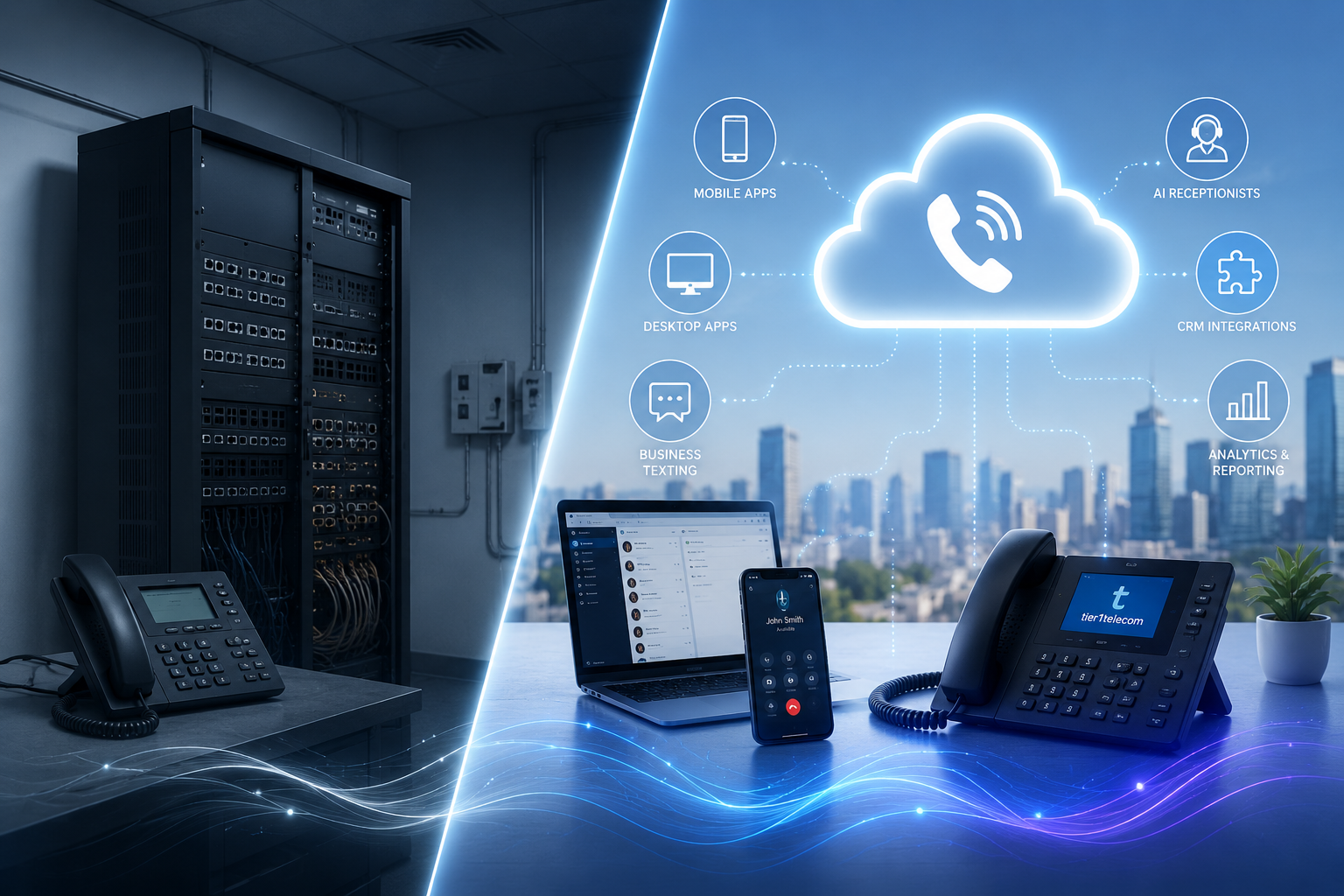
Tier 1 Telecom provides cloud phone systems, professional desk phones, mobile and desktop applications, advanced call routing, business texting, analytics, supported integrations, and optional AI voice agents.
More importantly, we provide a local service relationship.
Tier 1 serves businesses throughout Florida’s Treasure Coast, including Port St. Lucie, Fort Pierce, Stuart, Jensen Beach, Palm City, and Vero Beach. We combine telecom experience with real-world IT and network knowledge, allowing us to consider how the phones, internet connection, firewall, Wi-Fi, devices, and business applications work together.
Our process begins with your business—not a generic package:
- We review your current phone service, users, numbers, equipment, costs, and call flow.
- We design a system around your departments, schedules, locations, and customer experience.
- We configure and test the approved environment before final number porting.
- We coordinate launch and remain available to support the system afterward.
Tier 1 does not require a long-term service contract. We believe the quality of the system and the support relationship should earn your continued business.
If you are comparing providers, start by sending us your current phone bill. We will help you understand what you are paying for, identify unnecessary complexity, and show you what a modern phone system could look like for your organization.
Frequently Asked Questions
Is a local business phone provider always better?
Not automatically. The provider must still offer a reliable platform, sound technical planning, clear pricing, and capable support. The advantage of a strong local provider is accountability, familiarity with your business, and support from people who can understand your complete environment.
Should I choose the lowest phone-system quote?
Not without comparing what each proposal includes. Review equipment, setup, porting, apps, texting, recording, integrations, taxes, support, training, and contract terms. The lowest initial price may not represent the lowest total cost or the best service.
Can we keep our existing phone numbers?
Eligible business phone numbers can often be transferred. The current carrier, account information, number type, and authorization must be reviewed before a provider can confirm the porting plan.
Do we have to replace every desk phone?
Not necessarily. Existing devices must be evaluated for compatibility, condition, licensing, and configuration. Some employees may also prefer supported mobile or desktop apps instead of a physical phone.
How long does switching providers take?
The timeline depends on the number of users, devices, locations, call-flow complexity, equipment availability, training, and number-porting requirements. A careful provider should complete discovery and configuration before setting expectations for the final launch.
What should a provider test before launch?
Testing should cover inbound and outbound calling, caller ID, extensions, transfers, queues, auto attendants, business-hours and after-hours routing, voicemail, applications, emergency-calling configuration, and any approved texting or integrations.
FREE BUSINESS RESOURCE
Test Your Internet for Business Phone Systems
Wondering whether your Internet connection is ready for cloud business phones?
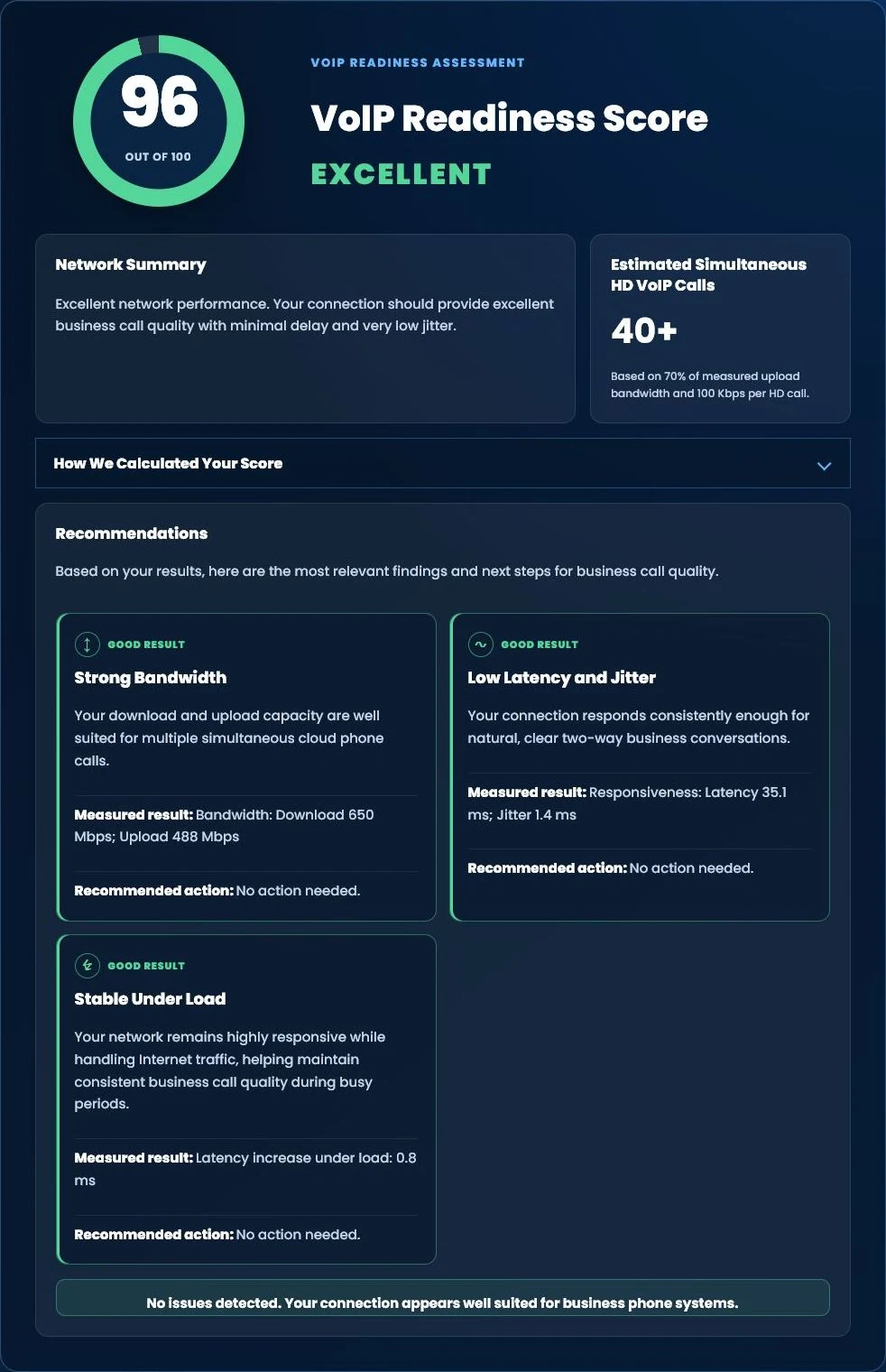
Run our free Tier 1 VoIP Readiness Assessment to measure latency, jitter, network responsiveness and overall VoIP readiness in about one minute.
- VoIP Readiness Score
- Latency & Jitter Analysis
- Network Stability Assessment
- Estimated HD Phone Capacity
Choose the Provider, Not Just the Platform
Business phone technology matters, but technology alone does not design your call flow, prepare your employees, coordinate your number transfer, or answer the phone when you need support.
Choose a provider that learns your business, explains your options, plans the transition, and remains accountable after installation.
As part of that comparison, ask how a provider manages number porting day, carrier coordination, and final call testing.
For Florida businesses, working with a local provider can create a more personal and responsive support relationship—especially when that provider understands both telecommunications and the technology environment behind it.
Tier 1 Telecom is ready to help you compare your current service and evaluate the right system for your organization.