

Business Text Messaging for Treasure Coast Companies
Tier 1 Telecom helps businesses add supported texting workflows to a professional communications environment. Employees can manage customer updates, scheduling conversations, service notifications and other appropriate messages through a consistent business identity when the selected number, platform and messaging route are properly configured.
What Is Business Text Messaging?
Business text messaging allows appropriately enabled business numbers and supported platforms to send and receive SMS—and MMS where supported—for legitimate business communication. Authorized employees may work from a desktop application, browser, mobile app, shared team inbox or an integrated business communications platform, with supported CRM and workflow connections available in some environments.
A business identity, not a personal workaround
Customer conversations can stay associated with a company-controlled number instead of an employee’s personal mobile number. This supports continuity and clearer ownership while giving the business more control over access.
Availability must be confirmed
Support depends on the provider, platform, number type, carrier, registration, use case and configuration. A landline, VoIP, toll-free or 10-digit number should not be assumed ready to message, and registration or consent requirements may apply even to conversational traffic.
Use Texting Where It Helps Customers Move Forward
The best messaging program starts with specific, expected conversations—not a purchased list or a vague plan to send bulk messages.
Scheduling
Appointment confirmations, reminders, rescheduling, reservation updates and availability conversations.
Field service
Technician-arrival notices, dispatch updates, estimate follow-up and active project-status communication.
Customer care
Requested information, account or service notifications and follow-up on an active customer request.
Operations
Internal alerts where supported, status notifications and coordinated handoffs between authorized team members.
Lead follow-up
Timely responses when appropriate consent exists and the message matches the disclosed and registered use case.
Promotional messaging
Only when the campaign, registration, consent and applicable requirements specifically support that traffic.
Build around permission and appropriate content
A responsible program avoids purchased or scraped numbers, cold bulk texting, shared consent, misleading sender identities, unregistered traffic and continued messages after opt-out. Sensitive information requires an appropriate privacy and security review, and ordinary business texting should not be treated as an emergency channel.
Give the Team a Clear Way to Own the Conversation
A professional messaging platform may let authorized employees access, assign or route conversations while keeping the business identity consistent. The exact capabilities depend on the selected platform.
- Reduce dependence on personal numbers
- Maintain continuity when an employee is unavailable
- Assign conversations and track status
- Use carefully reviewed templates
- Escalate from text to a telephone call
- Control access by employee role
- Maintain message history where supported
- Connect contacts or workflows where supported
Message history is useful operational context, but it does not automatically satisfy legal, healthcare, financial, record-retention or industry-specific obligations.
Choose Features That Fit the Workflow
Messaging channels
SMS, MMS where supported and a number-based business identity.
Team access
Shared inboxes, desktop and mobile access, assignment, notifications and user permissions.
Workflow tools
Templates, business-hours workflows, contact synchronization and supported CRM integrations.
Governance
Opt-out processing, reporting and message history where the platform provides them.
Feature names, integration compatibility, carrier support, limits and delivery behavior vary. A platform evaluation should confirm what is actually supported rather than assuming “unlimited” texting or universal delivery.
Business Texting Requires More Than Turning on a Feature
U.S. application-to-person messaging using a standard 10-digit long-code number commonly requires brand and campaign registration. Toll-free messaging generally follows a separate toll-free verification process, and other sender types may have different requirements.
Accurate registration information matters
Brands generally work through an appropriate messaging provider or Campaign Service Provider for 10DLC registration. Legal business information, the actual sender, intended use case, campaign description, message attributes, opt-in method and sample messages may be reviewed for consistency.
Approval and delivery are not guaranteed
Registration review can result in questions or requested corrections. Approval does not guarantee delivery, and carriers or providers may filter or block traffic. Requirements, fees, limits and review practices may change.
Consent and opt-out principles
- Consent should clearly identify the sender and intended message types.
- Providing a telephone number alone does not automatically create SMS consent.
- Consent should not be shared among unrelated businesses.
- Website SMS checkboxes should be optional, unchecked by default and placed near the disclosure.
- Retain appropriate consent records and honor STOP or similar reasonable opt-out requests.
- Where required or supported, send an opt-out confirmation; HELP responses should identify the brand and a support method.
- Messages should identify the sender and remain consistent with the registered use case; registration samples commonly need opt-out language.
These principles are operational guidance, not legal advice, and no single checkbox or disclosure guarantees compliance for every law, carrier rule or use case.
Make the Opt-In Experience Match the Actual Program
A registration reviewer may compare the live website, campaign description, sample messages and planned traffic. Businesses should document the exact steps a customer takes and obtain appropriate legal and compliance advice for their own use case.
Place the essentials near the choice
- Clear brand identity and specific message types
- Optional, unchecked SMS checkbox
- Message frequency and “Message and data rates may apply”
- STOP and HELP instructions
- Consent-not-a-condition-of-purchase language where appropriate
- A clear statement that a phone number alone is not SMS consent
Support the flow with public documentation
- Direct Privacy Policy and Terms and Conditions links
- Privacy language addressing mobile information and consent
- Messaging terms covering types, frequency, charges, HELP and STOP
- Documented opt-in steps and live-flow evidence where requested
- Consistent website, campaign, samples and actual traffic
Business Conversations Across the Treasure Coast
Home and field services
Appointment confirmations, technician-arrival notices, scheduling changes and requested service communication.
Professional and appointment-based offices
Reminders, rescheduling, requested document-status notifications and general office communication, subject to privacy needs.
Property and community teams
Showing coordination, maintenance updates, vendor communication and requested property-status notifications.
Retail, hospitality and customer service
Order status, reservation communication, availability updates and customer-care conversations.
These scenarios do not eliminate consent requirements or make every content type appropriate. Avoid sending medical details, financial account data, passwords, authentication secrets or other sensitive information without a suitable security and privacy plan.
Plan the Program Before You Launch It
Define the use case
Identify who will send messages, who will receive them and the message types the business intends to use.
Select numbers and platform
Confirm number eligibility, sender type and the supported platform that fits the workflow.
Prepare registration and consent materials
Gather accurate business information, campaign details, opt-in flow, policies, terms, samples and disclosures.
Configure and test
Set up users, permissions, templates, routing, opt-out and HELP behavior, notifications and integrations. Test only through an appropriately provisioned route.
Launch and monitor
Train users, monitor opt-outs and delivery issues, keep traffic aligned with the registered use case and update the process as requirements or needs change.
Registration and launch timing varies; it should not be treated as immediate.
Business Text Messaging FAQs
Can a business use its existing telephone number for text messaging?
Sometimes, but eligibility must be confirmed. The number type, current carrier, messaging provider, platform, ownership, porting status, registration and intended use case can all affect whether an existing number can be enabled.
What is A2P 10DLC registration?
It is an industry registration process commonly used for U.S. application-to-person messaging sent over standard 10-digit long-code numbers. A brand generally works through an appropriate messaging provider or Campaign Service Provider to identify the actual business and describe the intended campaign. It is different from toll-free verification.
Does a customer providing a telephone number automatically give permission to text them?
No. A telephone number may be provided for a call or another purpose. SMS consent should be clear, conspicuous and matched to the sender and intended messages; businesses should obtain advice appropriate to their use case.
Can multiple employees share business text conversations?
Some supported platforms provide shared inboxes, assignments, permissions or team access. Capabilities vary, so the chosen system should be evaluated for ownership, privacy, continuity and record needs.
Are SMS and MMS available on every business number?
No. Support varies by number type, carrier, provider, platform, registration, use case and configuration. MMS availability and limits can also differ from SMS.
What happens when a recipient replies STOP?
The sender and platform should honor STOP and similar reasonable opt-out requests. Where required or supported, the recipient receives an opt-out confirmation and further messaging is suppressed unless a valid re-opt-in occurs.
How long does business-texting registration take?
Timing varies with the provider, brand verification, campaign type, submitted information, reviewer requirements and whether corrections are requested. No approval timeline—or approval itself—can be guaranteed.
Check Your 10DLC Registration Readiness
Review your website, customer-consent process, policy disclosures and sample messages for common registration issues before preparing a business-texting campaign.
See complete results before providing contact information. This preparation tool does not submit a registration or guarantee approval.
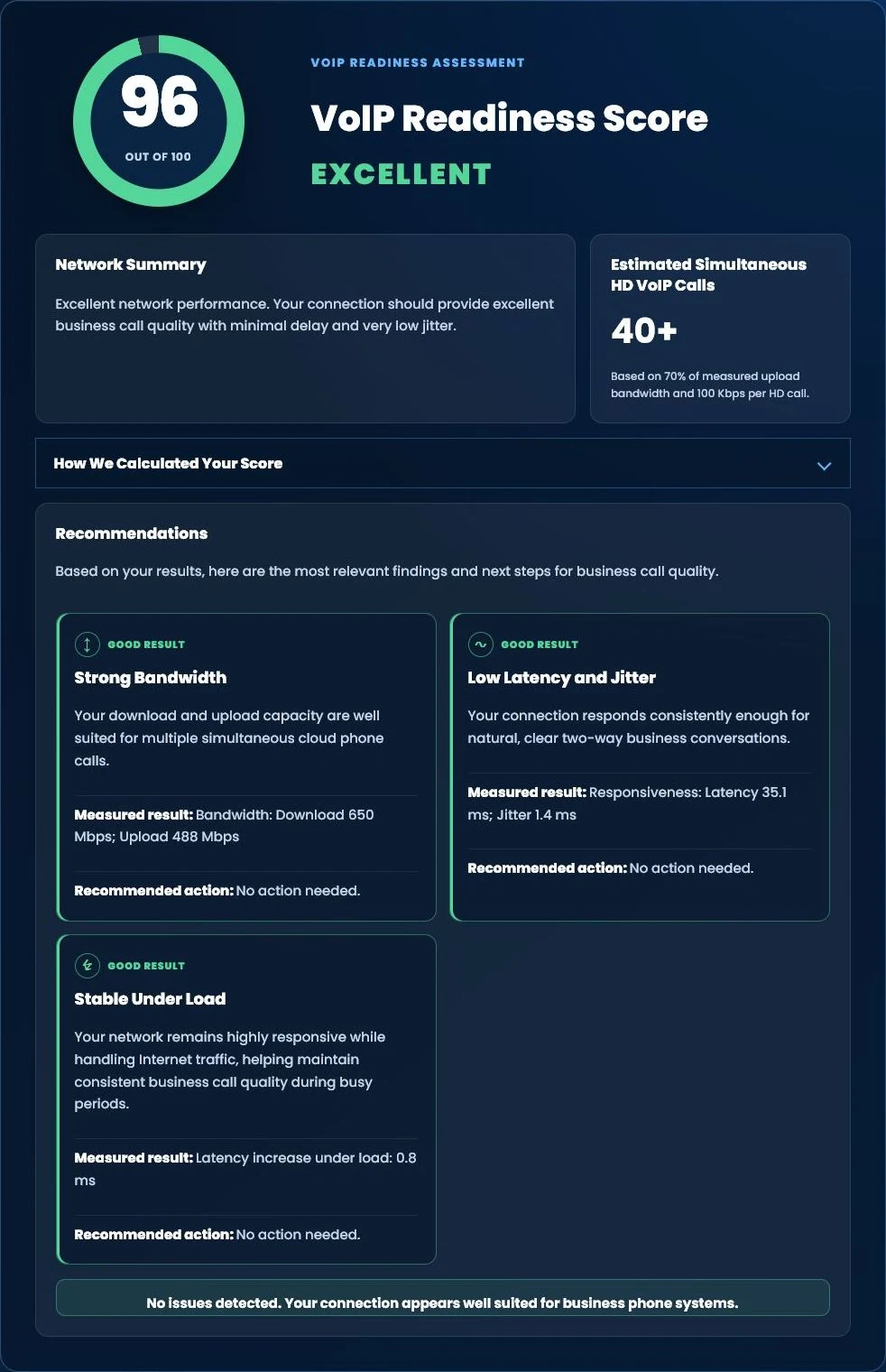
Is Your Internet Ready for Cloud Phones?
Before investing in a hosted phone system, make sure your network is ready.
Our free Tier 1 VoIP Readiness Assessment measures download speed, upload speed, latency, jitter and network responsiveness to determine whether your Internet connection is suitable for crystal-clear business calling.
- ✓ Measures network quality in about one minute
- ✓ Calculates a VoIP Readiness Score
- ✓ Estimates simultaneous HD call capacity
- ✓ Free with no registration required
Run the Free VoIP Readiness Assessment
Designed specifically to evaluate Internet connections for cloud business phone systems.
Plan Business Texting Around Your Actual Customer Workflow
Discuss intended message types, existing business numbers, employee access, customer opt-in methods, platform requirements, registration needs, integrations and how messaging should work alongside the phone system.