BUSINESS PHONE NUMBER PORTING
Switching business phone providers does not normally mean changing the telephone numbers your customers already know. Instead, eligible numbers are transferred—or ported—from the current carrier to the new one.
Porting day is the point when that transfer becomes active.
Before the port, calls to your established numbers still route through your current provider. After the port completes, those same numbers route through your new business phone system.
The important thing to understand is that porting day should not be the day your new system is first assembled. A well-managed transition does most of the work beforehand: phones are configured, extensions are created, call flows are programmed, users are prepared and the replacement system is tested.
By the time the numbers move, the new system should already be waiting for them.
QUICK ANSWER
The Quick Answer
On business phone number porting day, the losing carrier releases your approved telephone numbers and the receiving carrier activates them on the new service. Incoming calls begin routing through the new system, and the new provider verifies that calling, routing, voicemail and other approved features work correctly.
There may be a brief transition while carrier routing updates. Careful planning, accurate account information and testing completed before the port all help reduce the risk of disruption.
Do not cancel your existing phone service before the port is complete. Disconnecting the old service too early can put the telephone numbers—and the entire transfer—at risk.
NUMBER PORTING BASICS
What Is Business Phone Number Porting?
Phone number porting is the process of moving an existing telephone number from one service provider to another.
According to the Federal Communications Commission, number porting can occur between wireline, IP and wireless providers. That is what allows a company to replace an older landline, cable-company phone service or another VoIP provider while keeping the business numbers printed on its website, signs, vehicles, advertisements and customer records.
The phone number stays the same.
What changes is the carrier and phone system responsible for delivering calls to that number.
If you are still determining whether your numbers are eligible to move, start with Can I Keep My Existing Business Phone Numbers?.
BEFORE PORTING DAY
What Tier 1 Prepares Before Porting Day
Most of the work involved in switching providers should happen before the final number transfer.
At Tier 1 Telecom, the replacement system can be built around the way the business actually handles calls. Depending on the approved configuration, preparation may include:
- Creating users and extensions
- Programming desk phones
- Setting up mobile and desktop applications
- Recording or uploading auto-attendant greetings
- Building business-hours and after-hours routing
- Configuring ring groups and call queues
- Preparing voicemail boxes and voicemail-to-email delivery
- Setting up caller ID
- Configuring departments, menus and extension dialing
- Preparing failover or alternate-routing destinations
- Testing approved integrations and optional AI Voice Agents
The goal is to have the new platform configured and tested before the established numbers arrive.
Temporary numbers may be used during this stage so Tier 1 and the customer can place test calls, confirm routing and make adjustments without changing the live business service.
This preparation is one reason the complete switching process takes longer than the final cutover itself. For a broader look at project timing, see How Long Does It Take to Install a Business Phone System?.
PORTING DOCUMENTATION
What Information Is Needed to Port Business Phone Numbers?
A carrier will not release business telephone numbers based only on a list provided by the new phone company. The port request must match the current carrier’s records.
Common requirements include:
- A recent copy of the current phone bill
- The exact business or account-holder name
- The service address shown on the carrier record
- The current carrier account number
- An account PIN or passcode, when required
- A complete list of numbers being transferred
- A signed Letter of Authorization
- The name and authority of the person approving the transfer
The exact requirements can vary by provider and number type.
Even a small mismatch can cause a port request to be rejected. For example, the name customers use publicly may differ from the legal name stored by the carrier. A suite number may appear on one document but not another. A cable provider may use a separate voice account number that is not obvious on the first page of the bill.
That is why the current phone bill is so valuable. It gives us a starting point for identifying the services, numbers and carrier information connected to the account.
SCHEDULED CUTOVER
What Happens Before the Scheduled Porting Window?
Once the losing carrier accepts the request, the receiving carrier normally provides a confirmed transfer date. In telecom terminology, this is often called a firm order commitment, or FOC.
Before that date, Tier 1 confirms that:
- The new phone system is configured
- Phones and applications are ready
- The customer-approved call flow is in place
- Porting information matches the accepted order
- Employees know when the transition is expected
- Someone is available to help test incoming and outgoing calls
- Alternate contact information is available if needed
The existing phone service normally remains active during this preparation period. Calls continue reaching the old system until the carriers complete the transfer.
Porting should not be treated as a reason to cancel the current account early. The number must remain active and controlled by the current carrier until it is released through the approved porting process.
PORTING DAY SEQUENCE
What Happens During the Actual Transfer?
The technical work occurs between the losing carrier, the receiving carrier and the systems responsible for routing calls.
From the customer’s perspective, porting day generally follows this sequence.
1. The existing numbers remain active on the old service
Before the transfer begins, calls should continue routing through the current provider. Employees may still be answering the old phones while the new equipment is ready nearby.
2. The losing carrier releases the approved numbers
The current carrier processes the authorized transfer and releases the numbers included in the accepted order.
Only the approved numbers should be assumed to be part of the port. Additional lines, fax numbers, alarm lines, elevator phones or bundled services require separate review.
3. The receiving carrier activates the numbers
The numbers are assigned to the new carrier and mapped to the new Tier 1 Telecom system.
At that point, calls to the established business numbers begin arriving through the replacement platform instead of the old service.
4. Carrier routing updates
Different telephone networks may recognize the change at slightly different moments. A brief transition can occur while routes update.
This is why testing should include calls from more than one outside network when practical. A call from one mobile carrier may reach the new system before a call from another carrier or landline follows the same route.
5. Tier 1 verifies the new call flow
Once calls begin reaching the new platform, the focus shifts to verification.
We confirm that callers reach the correct greeting, auto attendant, queue, ring group, user, voicemail box or other approved destination.
If something does not behave as expected, we determine whether the issue involves carrier routing, the port order, a number assignment or the programmed call flow.
BUSINESS CONTINUITY
Will My Business Experience Downtime?
A properly planned port is designed to minimize disruption, but no provider should pretend that every carrier transfer is identical or guarantee that nothing unexpected can happen.
During the actual handoff, there may be a brief period when:
- Some outside networks reach the new system before others
- A call follows an old route that is being replaced
- An individual number activates before the rest of a group
- Inbound and outbound calling become available at slightly different times
- A feature connected to a number requires additional provisioning
The best protection is preparation.
The new system should already be built and tested. Employees should know what to expect. The provider should be watching the transfer and ready to verify calls as soon as the number activates.
In some situations, temporary routing or forwarding may also be available, but the appropriate option depends on the current carrier, number type and project design.
POST-PORT VERIFICATION
What Does Tier 1 Test After the Port?
The exact checklist depends on the customer’s system, but post-port testing commonly includes:
- Calling the main number from outside the business
- Testing direct-dial numbers
- Confirming the correct business-hours greeting
- Confirming after-hours routing
- Selecting auto-attendant menu options
- Calling individual extensions
- Verifying ring groups and queues
- Leaving and retrieving voicemail
- Confirming voicemail-to-email delivery
- Placing outbound calls
- Checking outbound caller ID
- Testing call transfers
- Confirming mobile and desktop applications
- Verifying approved failover destinations
Businesses with several locations, departments or specialized workflows may require a longer checklist.
Emergency-service address information should also be verified as part of the implementation. Test calls to 911 should never be placed casually; any emergency-calling test must follow the provider’s instructions and applicable public-safety procedures.
VOICE AND MESSAGING
What About Business Texting?
Voice calling and business texting use the same telephone number, but they are not always provisioned through the same process.
The voice port may complete before SMS and MMS are fully active on the new platform. Business texting can also require carrier registration, campaign approval or other compliance steps.
If texting is important to the business, it should be discussed during planning—not discovered after the voice service moves.
Tier 1 should know:
- Which numbers currently send or receive texts
- Whether employees use a shared texting inbox
- Whether automated or recurring messages are sent
- Whether the business already has an approved messaging campaign
- Whether website forms collect optional SMS consent
The voice port and texting transition can then be coordinated as related but distinct parts of the project.
SPECIALTY SERVICES
What About Fax Numbers, Toll-Free Numbers and Specialty Lines?
Not every telephone number should automatically be treated like the main office number.
Fax numbers, toll-free numbers, alarm lines, elevator phones, gate systems, credit-card terminals and other specialty services may have different requirements. Some should move to the new platform, some may need a replacement solution, and others may need to remain with the existing provider.
Before submitting a port request, every number on the bill should be identified and assigned a purpose.
This prevents a forgotten line from being disconnected or an unnecessary service from continuing to generate charges.
ACCOUNT REVIEW
Can Porting Affect Internet, Television or Other Bundled Services?
Yes, depending on how the current account is structured.
Many businesses purchase phone, internet, television and other services in one bundle. Moving the telephone numbers may disconnect the associated voice service, but it does not necessarily cancel every other service or financial obligation on the account.
In some cases, changing the voice portion of a bundle may also affect:
- Internet pricing
- Promotional discounts
- Equipment charges
- Television service
- Remaining contract obligations
- Final billing
That does not mean the business should avoid porting. It means the entire bill should be reviewed before anything is canceled.
Outstanding balances, early termination charges, equipment returns and services not included in the port remain the customer’s responsibility unless the current provider agrees otherwise.
AVOIDABLE DELAYS
Common Reasons Business Number Ports Are Delayed or Rejected
Most porting problems are not caused by the phone number itself. They are caused by information that does not match the losing carrier’s records or by an unresolved condition on the account.
Common causes include:
- Incorrect account number
- Incorrect account-holder name
- Service-address mismatch
- Missing suite or unit information
- Incorrect or missing PIN
- An unauthorized signer
- Missing Letter of Authorization
- A pending order already open with the current carrier
- A freeze or restriction on the account
- Numbers split across multiple accounts
- A disconnected or canceled number
- Numbers tied to a complex multi-line service
- A toll-free or specialty number requiring a separate process
When a request is rejected, the correction normally has to be submitted and reviewed again. That can change the expected transfer date.
The easiest way to avoid these delays is to provide complete, accurate documents at the beginning and respond promptly if the carrier requests verification.
For a complete prevention checklist, read why business phone number ports get rejected—and how to prevent them before the request is submitted.
When comparing proposals, also confirm whether number research, porting corrections, resubmissions and specialty-number handling are included. Our business phone quote comparison guide explains how to place those costs beside equipment, installation, support and contract terms.
BRAD’S ADVICE
Brad’s Advice: Never Cancel the Old Service First
One of the most important rules in any phone-provider transition is also one of the simplest:
Do not cancel your existing phone service before your numbers have successfully ported.
If the old provider disconnects a number before the receiving carrier completes the transfer, the number can become much harder to recover. At minimum, it can delay the project. In a worse situation, the business may temporarily lose control of a number customers have used for years.
Let the porting process move the number.
After the transfer is complete, calls have been tested and all remaining services have been reviewed, the old account can be addressed carefully.
EMPLOYEE PREPARATION
What Should Employees Expect on Porting Day?
Employees do not need to understand carrier routing or port-order terminology. They need a simple plan.
Before the scheduled transfer, employees should know:
- The expected porting date
- Which phones or applications they will use afterward
- How to sign in to mobile or desktop apps
- Whether extension numbers are changing
- Where voicemail will be delivered
- Who to contact if a call does not work
- Whether old phones should remain connected temporarily
Once the port completes, employees may be asked to place or receive a few test calls.
The transition is much easier when people know what is changing—and what is not.
Customers should still dial the same business number. The change happens behind the scenes.
AFTER THE CUTOVER
What Happens After Everything Is Working?
After calling and routing have been verified, the new system becomes the active communications platform.
Tier 1 and the customer should then confirm:
- Every expected number was transferred
- The old carrier did not retain a number that should have moved
- Specialty services were handled as planned
- Business texting status is understood
- Necessary equipment-return instructions are documented
- Remaining internet or television services are still correct
- The old provider’s final bill will be reviewed
- Employees know how to request support
The old account should not be ignored simply because the phones are working. Final invoices can reveal unreturned equipment, remaining services or charges that still need attention.
FREQUENTLY ASKED QUESTIONS
Frequently Asked Questions
Can I keep my existing business phone numbers?
In most cases, eligible business telephone numbers can be transferred to a new provider. The numbers must remain active, and the port request must match the current carrier’s account records.
How long does business phone number porting take?
The timeline varies by carrier, number type, quantity and account complexity. A simple port may be completed faster than a multi-location project involving many numbers, toll-free service or older carrier arrangements. The confirmed porting date is normally provided after the losing carrier accepts the request.
Should I cancel my old phone service before porting?
No. Keep the existing service active until the numbers have successfully transferred and calling has been verified on the new system.
Will customers know that we changed providers?
Customers should continue dialing the same business numbers. With a properly planned transition, most of the change happens behind the scenes.
Can we continue using our old phones before the port?
Usually, the current phone service remains active until the numbers transfer. Whether the physical phones can be reused afterward depends on their make, model, configuration and compatibility with the new platform.
Does business texting move at the same time as voice calling?
Not always. SMS and MMS provisioning may follow a separate carrier and registration process. Texting requirements should be reviewed before porting day.
What happens if a port request is rejected?
The provider identifies the rejection reason, corrects the information or obtains the required documentation, and resubmits the request. A rejection can delay the original transfer schedule.
FREE BUSINESS RESOURCE
Test Your Internet for Business Phone Systems
Wondering whether your Internet connection is ready for cloud business phones?
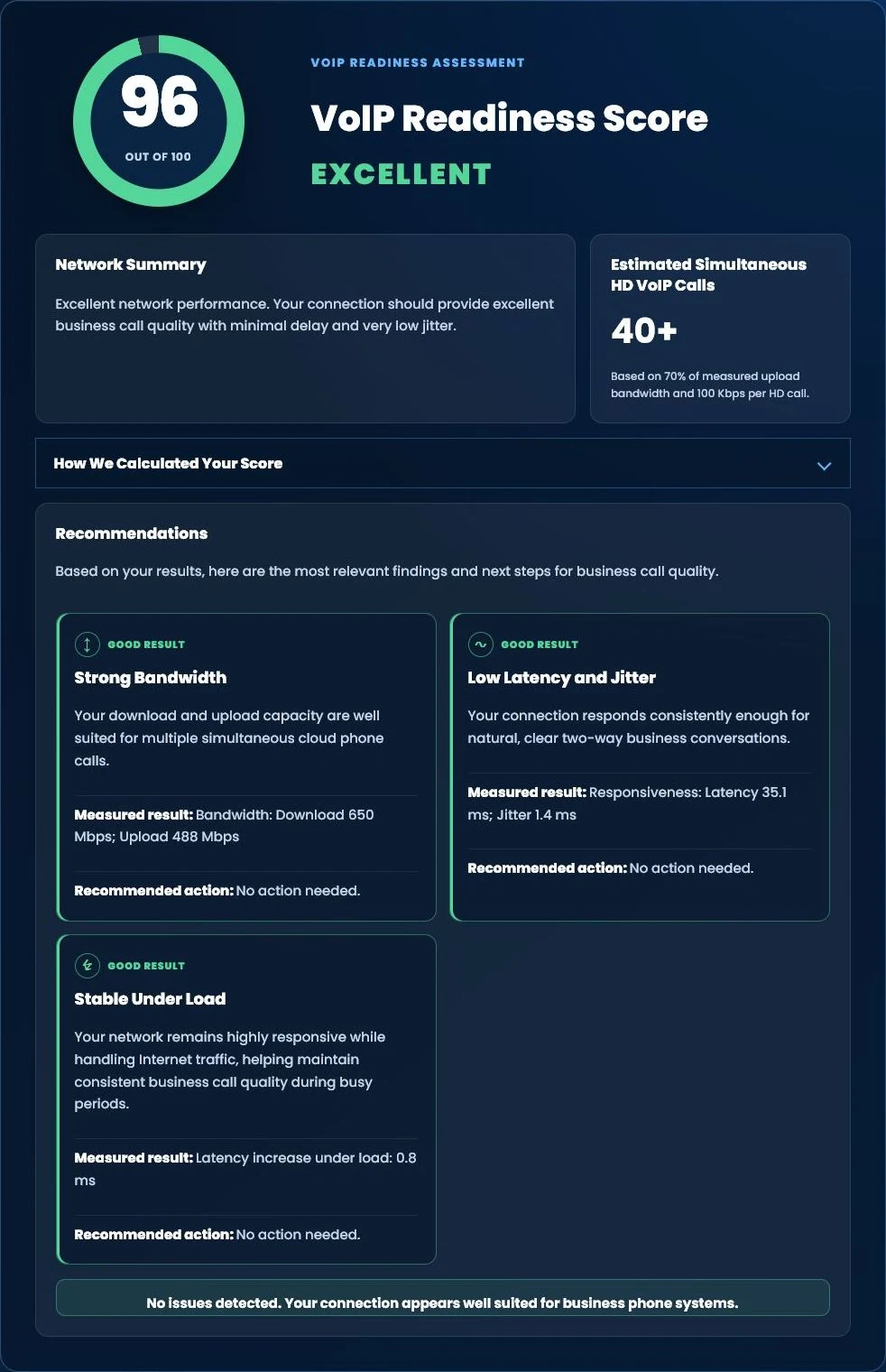
Run our free Tier 1 VoIP Readiness Assessment to measure latency, jitter, network responsiveness and overall VoIP readiness in about one minute.
- VoIP Readiness Score
- Latency & Jitter Analysis
- Network Stability Assessment
- Estimated HD Phone Capacity
PLAN THE TRANSITION
Make Porting Day the Final Step—not the First
Porting business phone numbers can sound intimidating because those numbers are directly connected to customers, sales, service and the company’s reputation.
But the actual transfer should be the final step in a carefully planned transition.
The new phone system should already be configured. Employees should already know what to expect. The call flow should already be tested. The account information should already match the losing carrier’s records.
Then, when the numbers move, the replacement system is ready to receive them.
If you are considering changing providers, start with the complete Switching Business Phone Providers Guide or review How to Choose a Business Phone System Provider.
The first thing Tier 1 Telecom needs is simple: a copy of your current phone bill.
We will review the numbers, services, equipment and account structure, explain what should move, identify anything requiring special attention and help plan the transition.